


Whispers of the Invisible
Presented by Mois Multi
Co-curated by Christian Lapointe (Mois Multi, Quebec), Seungah Lee (Urban Art Lab, Seoul) and Vincent Roy (EXMURO, Quebec) and presented as part of the 27th edition of the Mois Multi international festival of multidisciplinary and electronic arts.
In a world dominated by the visible, what remains unnoticed? Whispers of the Invisible delves into the forgotten, the fleeting, and the intangible—memories erased, sensations overlooked, and hidden connections that quietly shape our everyday lives. Bringing together artists from Quebec, the United States, France and Korea, the exhibition draws attention to the gaps, silences, and blind spots in perception, and asks how contemporary art might illuminate what lies beneath the surface of the senses.
With works by Jean-François Côté (Quebec), Mathieu Valade (Quebec), Pierre&Marie (Quebec), Lee Yongbaek, and Kira Kim (Republic of Korea), Maxime Corbeil-Perron (Quebec), Matthew Biederman (Chicago) and Lucas Paris (France),.

From January 31 to April 6, 2026

Aire publique EXMURO, Place Royale, Québec
JEAN-FRANÇOIS CÔTÉ (QUÉBEC)
Through immersive installations, Jean-François Côté engages in a conceptual, poetic, and critical exploration of image, sound, narrativity, and environment—examined through the lens of digital and ecological transitions. Confronting the omnipresence of mass media, he reimagines images as sensitive spaces to inhabit.
His work has been featured in numerous exhibitions across Canada, Mexico, Chile, Croatia, Greece, and China. A professor at the Université du Québec in Trois-Rivières, he is also cofounder of SYMBIOSE, an interdisciplinary laboratory dedicated to art, technology, and the environment. Côté is also active in the field of permanent public art.
INVISIBLE STORIES
Through immersive installations, Jean-François Côté engages in a conceptual, poetic, and critical exploration of image, sound, narrativity, and environment—examined through the lens of digital and ecological transitions. Confronting the omnipresence of mass media, he reimagines images as sensitive spaces to inhabit.
His work has been featured in numerous exhibitions across Canada, Mexico, Chile, Croatia, Greece, and China. A professor at the Université du Québec in Trois-Rivières, he is also cofounder of SYMBIOSE, an interdisciplinary laboratory dedicated to art, technology, and the environment. Côté is also active in the field of permanent public art.
MATHIEU VALADE (QUÉBEC)
Mathieu Valade’s art practice navigates the interplay between geometry, perception, and media. He constructs sculptural video installations and optical artworks that deconstruct the screen’s influence, employing repetition, reflection, and spatial fragmentation. His work exposes artifice, creates perceptual loops, and challenges viewers to slow down, observe, and rethink visual certainty.
Mathieu Valade is a Canadian artist whose work has been presented in museums, galleries, and artist-run centres across Canada, France, Belgium, Germany, Spain, Greece, the United States, and Sweden. His work is part of several institutional collections, and he has produced numerous permanent and temporary public art installations.
THE SKY AND WATER
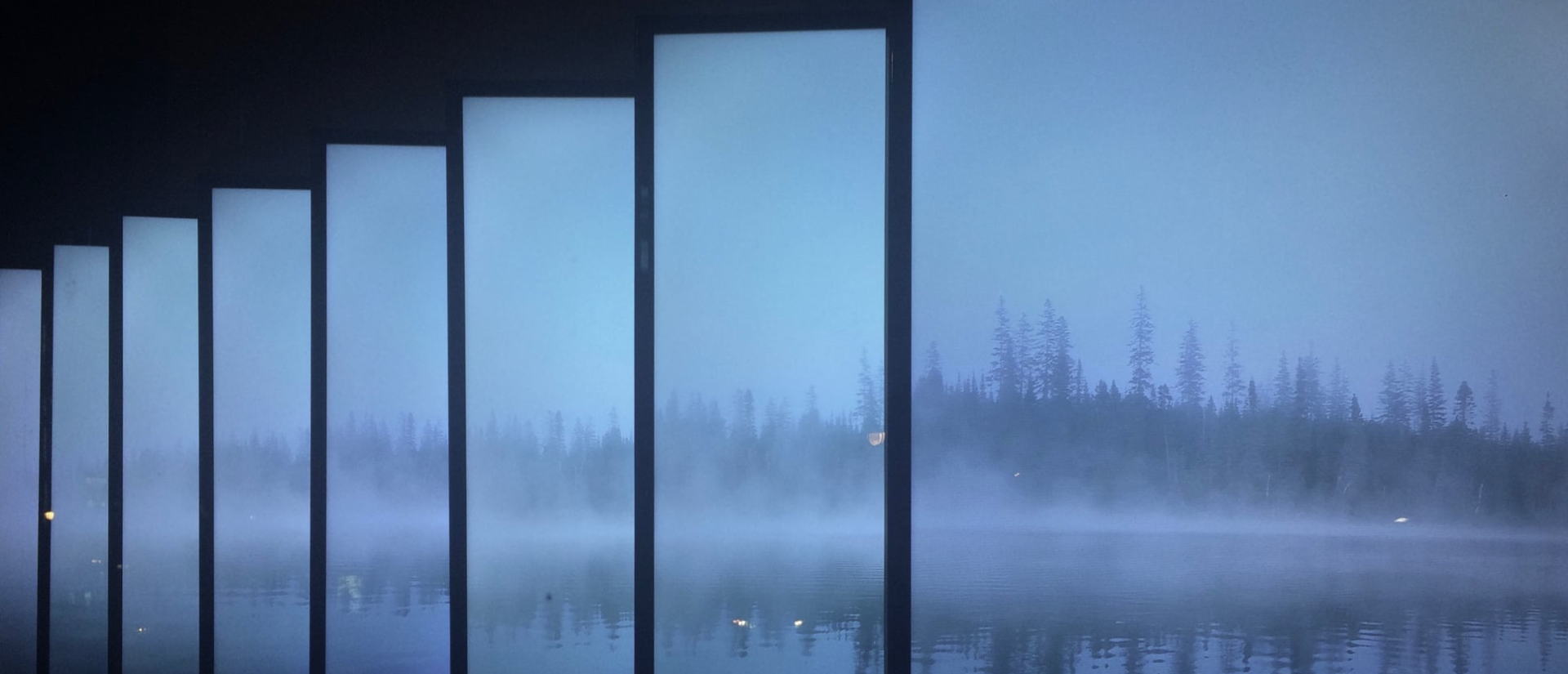
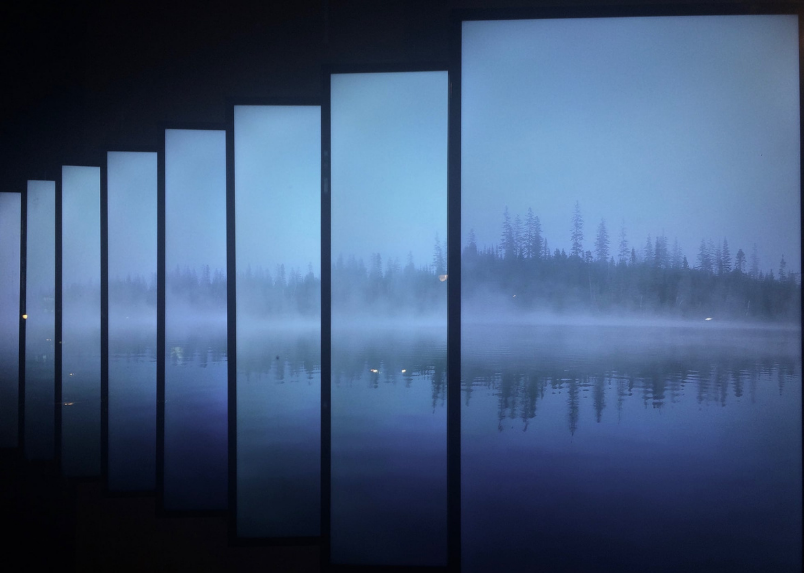
The Sky and Water by Mathieu Valade is a video installation featuring a sequence of vertically mounted televisions, tilted away from the wall and overlapping like pages of a half-open book. Each screen plays the same misty tracking shot across a lake, where sky, water, and the hazy silhouette of an island gradually emerge. Together, the screens form a fragmented yet unified image, inviting viewers to navigate both illusion and perception.
Valade’s practice engages with optical phenomena, repetition, and minimalist aesthetics to explore the boundaries between material form and visual complexity. Here, the television screen—ubiquitous in contemporary life—is transformed into a sculptural element, a luminous surface that challenges our habits of seeing. Through this subtle interplay of geometry, reflection, and motion, The Sky and Water disrupts linear viewing and emphasizes slowness, ambiguity, and aesthetic contemplation. It is a poetic meditation on the image, its mediation, and our desire to decipher what lies beneath its surface.
PIERRE&MARIE (QUÉBEC)
Pierre&Marie is the collaborative duo of Pierre Brassard and Marie-Pier Lebeau Lavoie, active since 2008 and based in Quebec City, Canada. Their work playfully reinterprets symbols of popular culture to reveal the absurdity and poetry of contemporary life.
Blending wonder and gentle resistance, their practice engages with pressing social issues.
The duo has presented over thirty exhibitions across Canada, France, and Taiwan, in museums, artist-run centres, and galleries. Their work is held in numerous public, private, and institutional collections, and they have received several awards and distinctions in recognition of their artistic contribution in Quebec.
BIG OTHER – DISCIPLINARY SOCIETIES
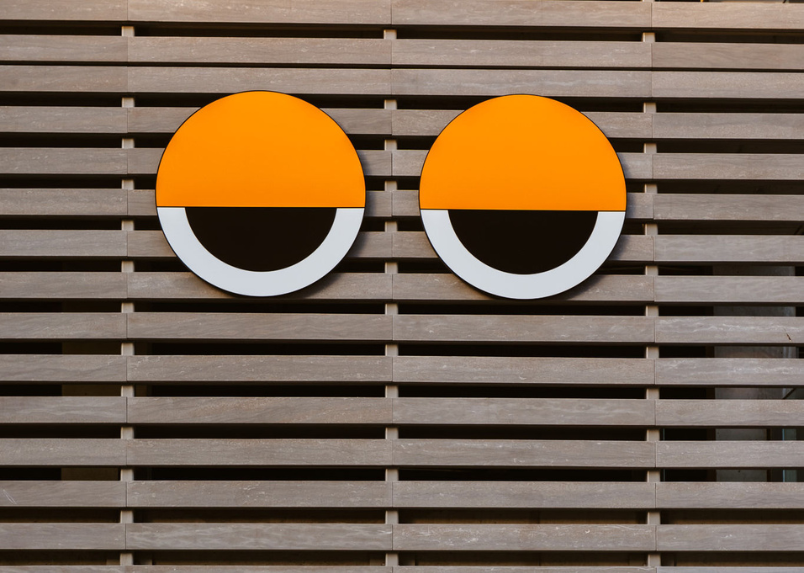
Big Other – Disciplinary Societies is an interactive installation that comes to life with the movement of people in front of the EXMURO’s Aire publique. Two circular LED screens take the shape of sleepy eyes, gradually awakening in response to participation, thanks to a motion detector oriented toward Place Royale.
By fixing these animated eyes onto the façade, the installation turns the building itself into an active observer, inviting playfulness while prompting reflection on surveillance and control. Drawing on a visual language inspired by familiar emojis, Big Other subtly explores issues of data collection and digital environment management. At the same time, the luminous eyes evoke a protective gaze, illuminating the street and encouraging viewers to consider the delicate balance between security and discomfort, care and monitoring.
Born from a collaboration with the Floworks agency and the Urban Art Lab, this work is technically derived from the Miro-Eye installation presented at the Miro Smart Lab in Gwangju, South Korea, until December 2027, and visually derived from Big Other (2023) by artists Pierre&Marie.
LEE YONGBAEK (Republic of Korea)
Lee Yongbeak has gained international recognition for his thought-provoking and innovative use of technology and media to reflect contemporary imagination and explore themes of beauty, violence and perception. He navigates various technologies from single-channel video to interactive art, sound art, kinetic art, and robotics to visualize stories about the human psyche, along with socio-political issues.
Born in Gimpo, Korea, Lee Yongbaek graduated from the Hoingik University in Korea and the Stuttgart State Academy of Art and Design in Germany. He was selected for the Korean Pavilion at the Venice Biennale in 2011 and has participated in the Moscow Biennale, the Busan Biennale, Gwangju Biennale, and the Nanjing International Art Festival.
ANGEL SOLDIER
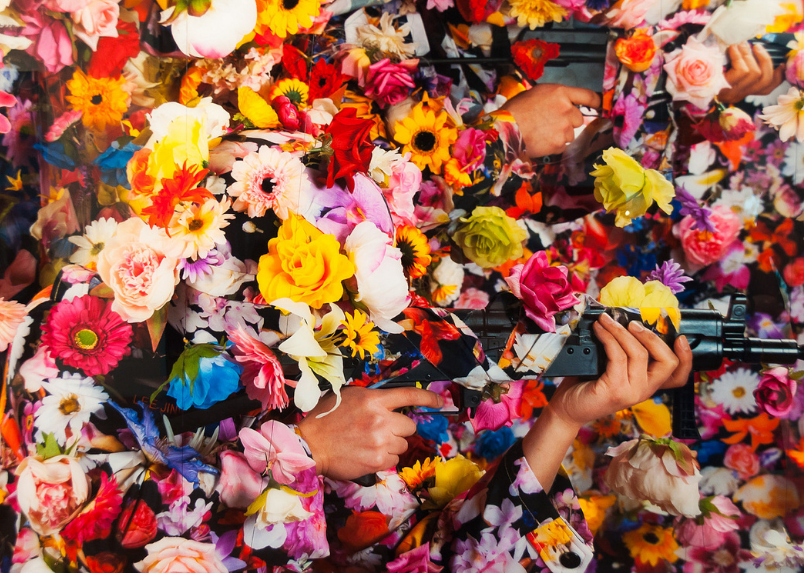
Angel Soldier by Lee Yongbaek is a haunting video installation that juxtaposes the delicate beauty of floral patterns with the stark reality of war. Set against a printed backdrop of colorful artificial flowers, six soldiers don uniforms made from the same floral fabric, transforming the scene into a surreal flower field. At first glance, the video appears to depict a serene, static landscape accompanied by the gentle sounds of nature. Yet, as the viewer’s eye lingers, the illusion unravels: blossoms subtly shift, revealing the camouflaged soldiers slowly creeping forward, their barely perceptible movements evoking an unsettling tension.
Through this interplay of aesthetic beauty and concealed militarism, the work challenges perceptions of surface appearances, inviting reflection on identity, conflict, and the seductive artifice of contemporary society. The contrasting figures of angel and soldier, nature and violence, coexist in a space of simulacre that is at once visually alluring and disturbingly unfamiliar, leaving a lingering sense of unease.
KIRA KIM (REPULIC OF KOREA)
Kira Kim’s multimedia practice humorously yet incisively critiques capitalist power structures and the false ideals they project. Drawing from personal experience, he deconstructs dominant narratives, amplifies marginalized voices, and probes social and psychological tensions, inviting viewers to confront uncomfortable truths embedded in contemporary Korean society and global capitalism.
Born in Dacheon, Korea, Kiram Kim holds an MFA from Goldsmiths, University of London. He has participated in international biennials in Gwangju, Busan, and Liverpool, and taken part in exhibitions at renowned institutions such as the National Art Museum of China. He was a finalist for the Korea Artist Prize and won the Korean Art Critics Association Artist Award.
BLIND MAN: DIFFERENT WAY
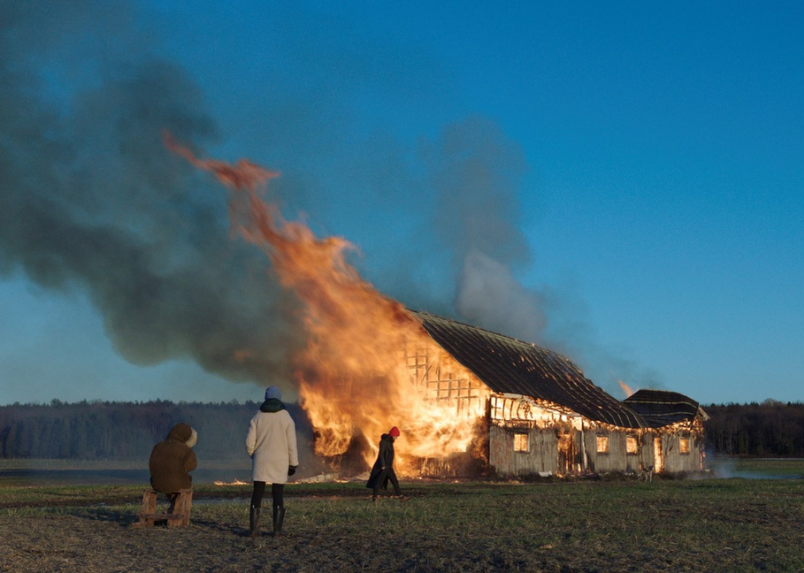
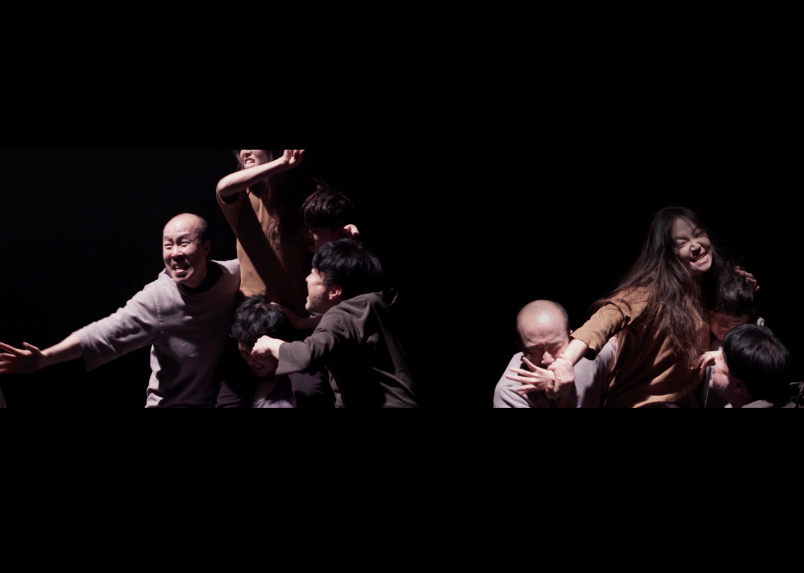
On a stage swallowed by darkness, a violent struggle unfolds in slow motion. Three figures appear locked in a desperate, every-person-for-themselves battle, clawing and shoving to lift themselves above the others. Their silent screams dissolve into a piercing soundscape that amplifies the rising tension. As the camera draws back, more bodies emerge: five figures in total, all precariously supported by a single man who sways beneath their collective weight yet refuses to collapse.
This chaotic physicality becomes a searing metaphor for the individualistic competitive drive shaped by contemporary capitalism. Kira Kim exposes the paradox of a hierarchical system in which the survival of some rests on the oppression of others, highlighting the fragility of the ideologies that structure our lives. Blind Man: Different Way probes the human condition today, revealing how collective systems shape our relationships, behaviours, and responsibilities toward one another.
Maxime Corbeil-Perron (QUÉBEC)
Maxime Corbeil-Perron (he/him) is an artist based in Tiohtià:ke/Mooniyang/Montreal whose artistic practice spans a variety of mediums: audiovisual performance, experimental cinema, electroacoustic composition, improvisation, sound art, and installation.
As a director, he has received, among others, the award for best experimental animation at the Ann Arbor Film Festival (2021), the award for best artwork and experimentation at Rendez-Vous Québec Cinéma (Canada, 2020), and honorable mentions at Vienna Shorts (Austria, 2024) and FNC (Canada, 2019). He also received an honorable mention in the digital music and sound art category at Prix Ars Electronica (Austria, 2021).
PERMUTATIONS
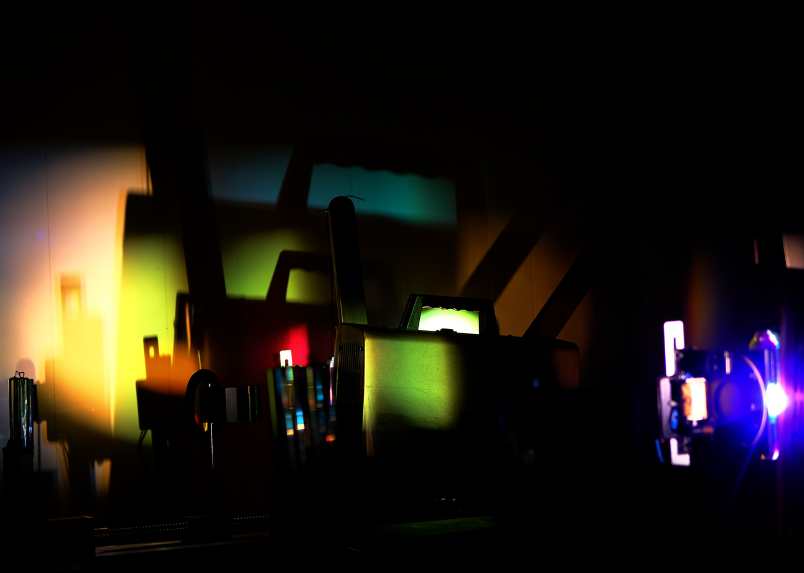
Permutations is a light and sound installation consisting of a trio of 16mm projectors enhanced by a handmade light control and distortion system. This work is part of an ongoing archaeological media art project focused on exploring the relationship between obsolete media and contemporary technologies, seeking to explore elements of the past in order to find new aesthetic possibilities.
These 16mm projectors, media objects now considered obsolete by mainstream trends, are enhanced here by a system combining digital and mechanical technology, which includes movable optical lenses and mechanized camera shutters.
Matthew Biederman (CHICAGO) et Lucas Paris (FRANCE)
Matthew Biederman is a multidisciplinary artist who has been exploring perception, data, and media systems through installation, performance, and video since the 1990s. His work has been featured in international biennials and festivals, and is included in public and private collections across North America.
Lucas Paris has been working in real time with sound and visuals and building digital instruments and software for over ten years. His research, applied to audiovisual performances, focuses on immersive audience engagement through multi-sensory and emotional content and scenography.
Situational compliance
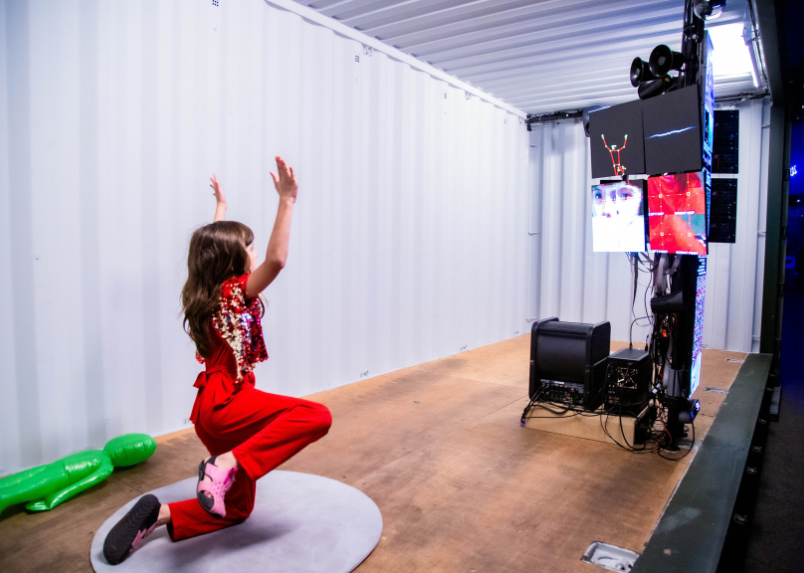
Situational Compliance is an interactive audiovisual installation that reimagines the game “Simon Says” to explore, with humor and insight, the mechanisms of public surveillance. Using artificial intelligence and computer vision, the work presents a system that observes, interprets, and directs the actions of the audience, revealing the power dynamics at work in our digital environments.
We are invited to follow simple instructions. Each posture performed becomes both an act of individuality and a negation of identity in a digitally mediated environment. The device places the body at the center of a game of control, between autonomy and algorithmic injunction.

EXMURO public art thank to the Museum of Civilization for its valuable support for this exhibition.
